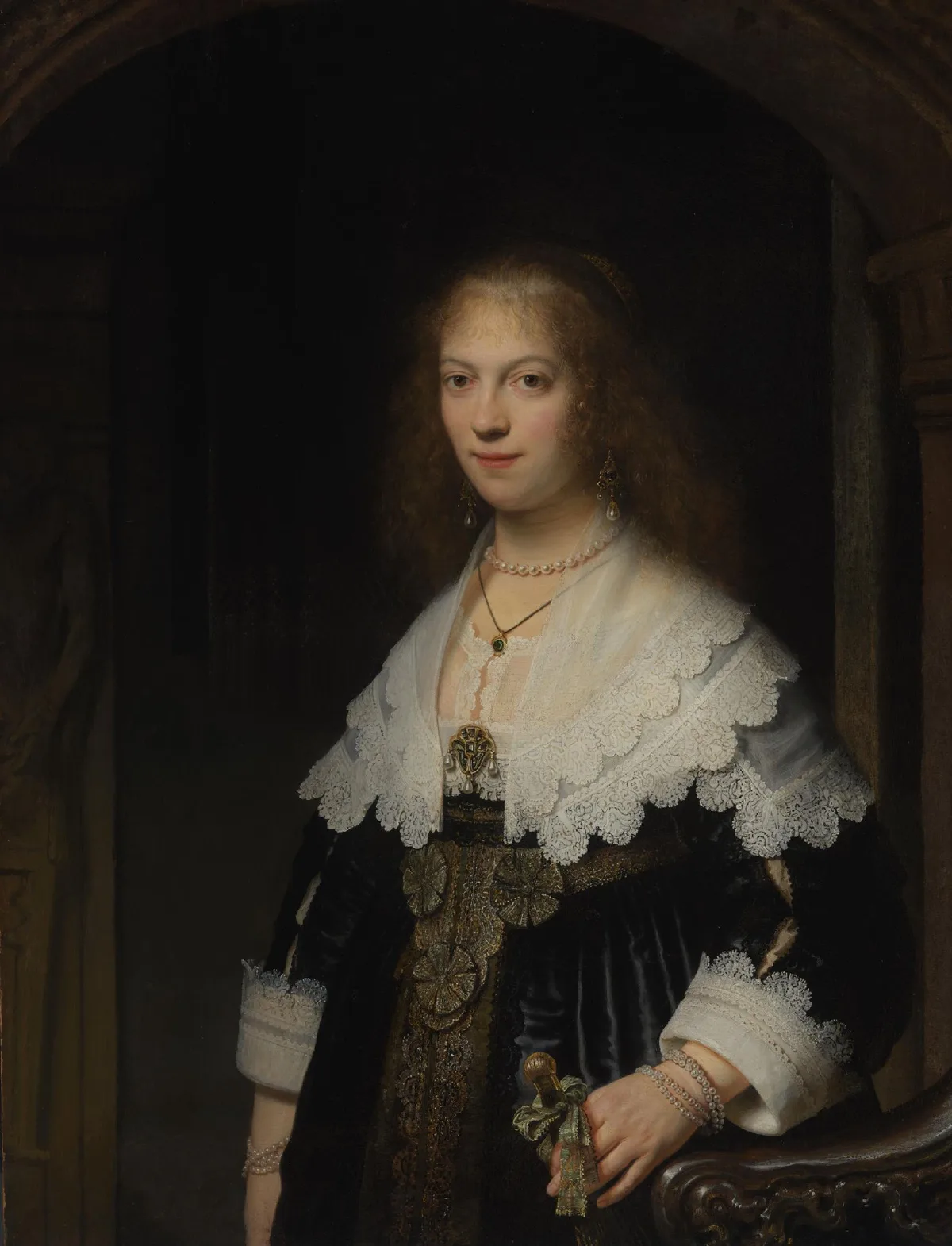
Triangle composition is one of those ideas that sounds almost too simple — until you start seeing it everywhere you look. In Rembrandt's portrait above, the sitter's illuminated face, the brilliant lace collar, and the clasped hands describe a triangle so steady and self-contained that the figure reads as completely settled inside the frame. That structural calm is exactly what triangle composition in painting and drawing can give you, and once you know what you're looking for, you'll spot it in portraits, landscapes, figure groups, and still lifes across five centuries of Western art.
This post covers how triangles work, the main types you'll encounter, and — most usefully — how to audit your own work when a painting feels restless or unstable without your quite knowing why.
What Is Triangle Composition?
Triangle composition means organizing the main elements of a picture so they sit at the three points of an implied or literal triangle. The triangle itself is almost never drawn; it exists as a felt relationship between forms — three heads in a group portrait, the peak of a mountain and its two footings, a highlight on a figure's shoulder, knee, and hand.
What makes the triangle useful is geometry. Of all simple polygons, the triangle is the only inherently rigid shape — it cannot distort under load without one side changing length. That structural fact translates, perceptually, into a sense of stability and resolution. A composition built on a triangle tends to feel grounded. A composition built on a rectangle or square can feel inert by comparison, and one with no strong shape at all often reads as scattered.
Triangles also direct movement. Because they have a single apex, the eye tends to travel around the three points before settling — which means the painter controls that journey. Point the apex upward and the composition feels monumental, almost architectural. Tip it sideways and it starts to feel dynamic, even precarious.
Why Triangles Work So Well
They create a closed circuit for the eye
When three elements form a triangle, the eye moves from one to the next and loops back rather than sliding off the edge of the canvas. This is closely related to the idea of a focal point in painting: the triangle doesn't just mark where you want the viewer to look first — it defines the whole path of looking. Compare this with a line of three elements running straight across the canvas. The eye enters, scans left to right, and exits. The triangle keeps the viewer inside the picture.
They signal hierarchy
A stable triangle has one apex and a broader base. Instinctively, the apex reads as the most important point — the place of greatest "pressure." Painters use this to establish hierarchy without heavy-handed contrast: the face sits at the apex, the shoulders form the base, and you know immediately who and what the picture is about.
They work at every scale
You can build a triangle across an entire landscape — mountain peak, foreground left, foreground right — or within a single figure study, using just the head, one elbow, and a knee. That scalability makes the triangle one of the most adaptable tools in composition in art.
The Main Types of Triangle Composition
The stable upright triangle
Base wide, apex up. Think of the pyramidal compositions of the Italian Renaissance — Raphael's Madonna of the Meadow (1506, Kunsthistorisches Museum) is the textbook example, with the Christ child at the base, the young John the Baptist to one side, and the Virgin's head at the peak. The shape echoes the architecture of a pediment, and it conveys exactly the same message: solidity, permanence, dignity. Portrait painters reach for this arrangement constantly, because it makes a sitter look composed.
The dynamic diagonal triangle
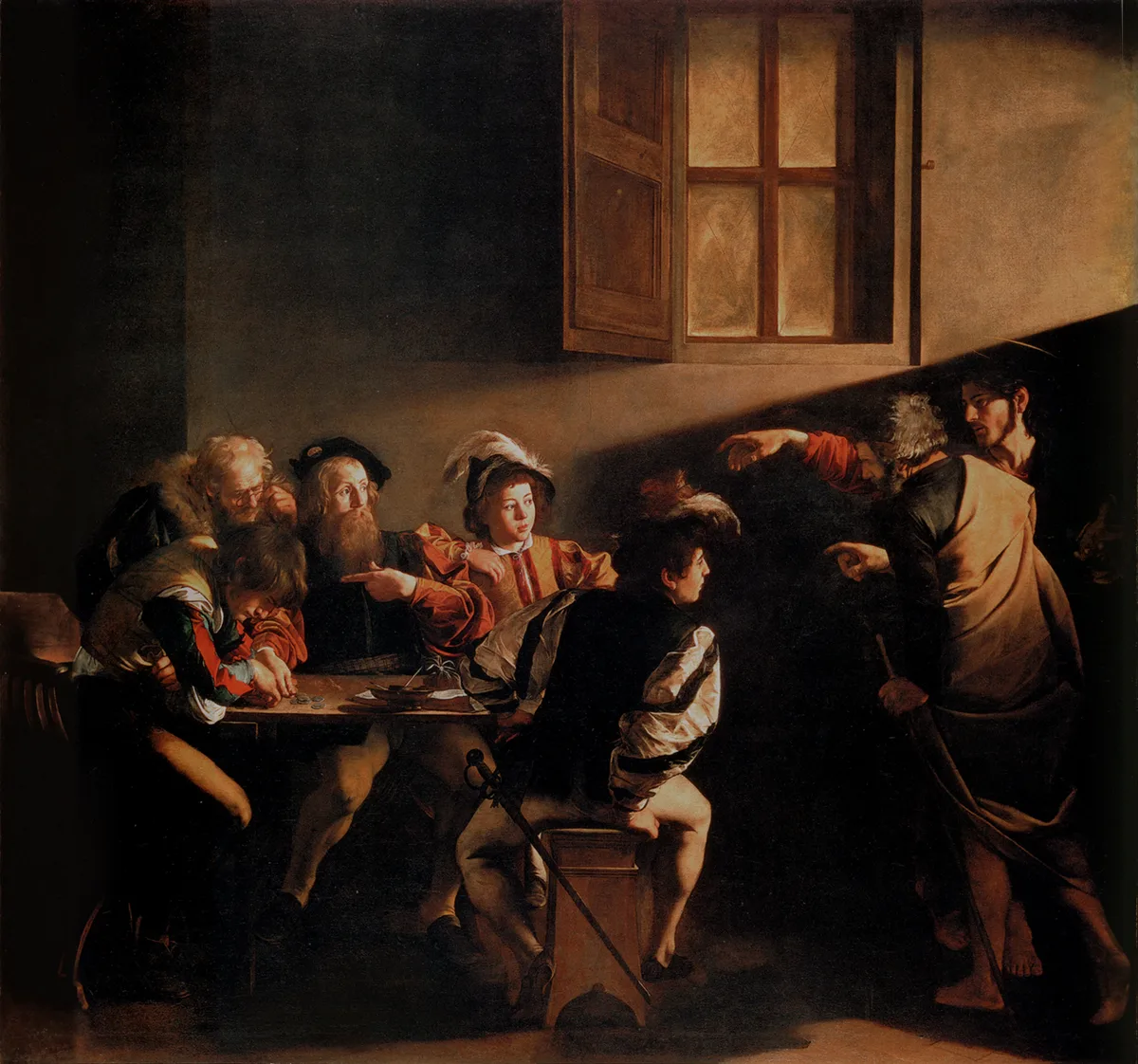
Tip the triangle onto its side — or let the apex drop below center — and the whole feeling shifts. Caravaggio's The Calling of Saint Matthew (c. 1599–1600, above) uses a long diagonal slab of light to connect Christ's extended arm on the right with Matthew's startled, self-pointing gesture on the left. The triangle implied by that light, Matthew's raised hand, and the hunched figures at the table is anything but stable — it's arrested motion, as if the scene is mid-fall. That tension is exactly right for the subject. A diagonal triangle suits action, drama, and narrative; an upright triangle suits authority and permanence.
The golden triangle
The golden triangle is a specific construction: draw a diagonal from corner to corner of the rectangle, then drop a perpendicular from one of the remaining corners to that diagonal. You get two large triangles and one smaller one sharing a corner, all similar to each other in proportion. Elements placed along those diagonals — a horizon line, a falling figure, a shaft of light — feel both dynamic and harmonious, because the proportions echo throughout the frame. It's worth being honest: painters rarely drew this grid on their canvases deliberately, and claims about "golden ratio intent" in old masters should be treated with caution. But the grid is a genuinely useful analysis tool. You can read more about the related question of geometric grids in The Golden Spiral in Art: What Painters Actually Need to Know.
Implied and negative triangles
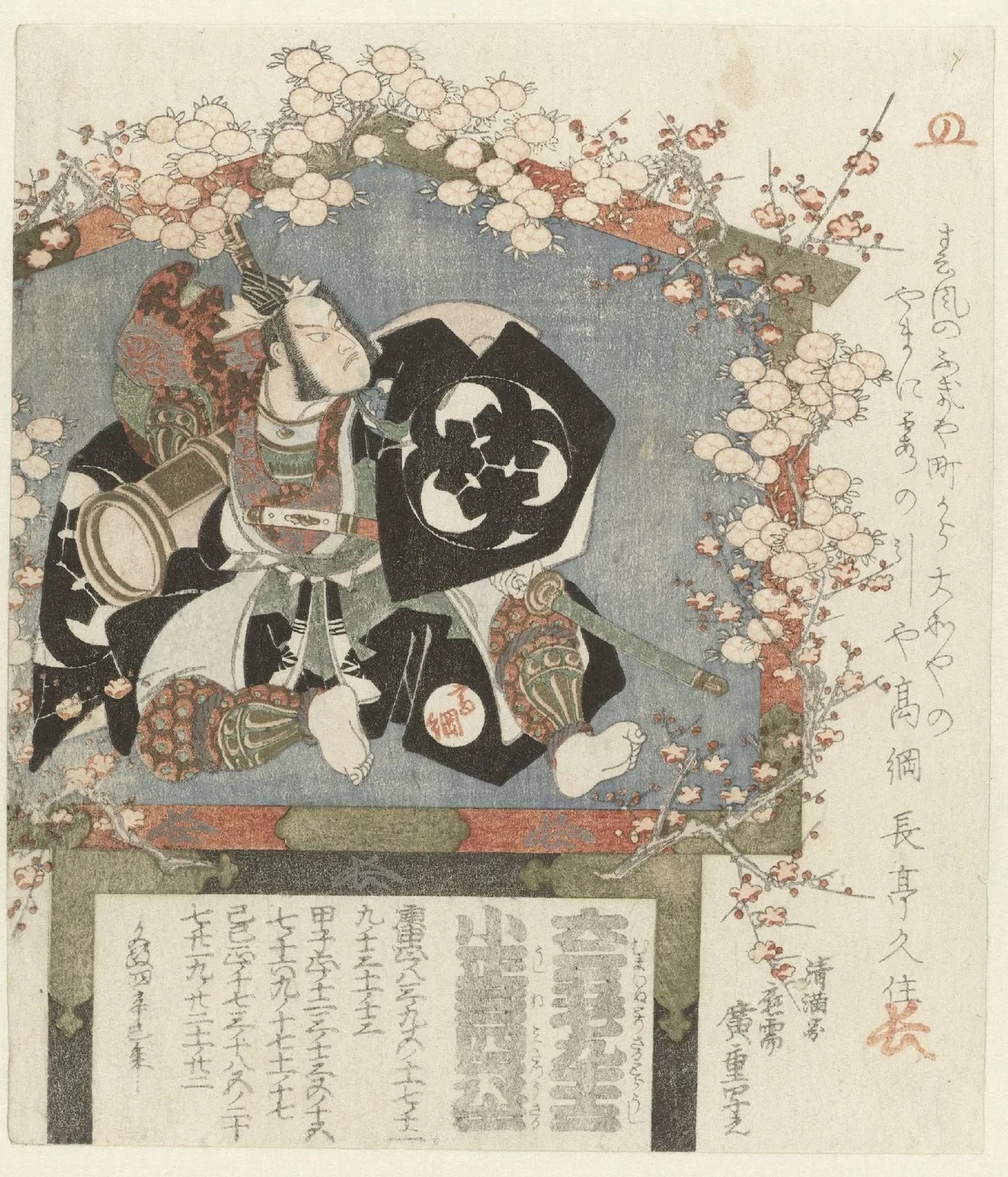
Not every triangle is formed by three objects. Sometimes the triangle is carved out of negative space — the gap between a figure's arm and torso, or the shadow wedge between two forms. Hiroshige understood this intuitively: in his woodblock prints, the composition often hinges on a triangular patch of open ground or sky that gives the eye somewhere to rest between more complex passages. Implied triangles can be just as structurally powerful as explicit ones, and they tend to read as more sophisticated because they're not announced.
Diagnose Your Own Work
When a painting feels unsettled — when it won't hold still no matter how much you adjust the edges or push the values — it's worth asking whether the main elements have any underlying geometric logic. Here are the self-checks I find most useful.
Connect the three brightest points. Dab a finger on the lightest light, the second lightest, and the third. What shape do those three points make? If they sit in a straight line, the eye has nowhere to turn. If they cluster, there's no journey at all. A triangle, even a loose one, is usually what you want.
Look at your darks the same way. Find your three deepest darks and connect them. Do they describe a shape that's in dialogue with your lights — or are they fighting an independent battle? The relationship between your light triangle and your dark triangle is most of your composition. This is the core idea behind notan art — reducing everything to two values to see the shape structure clearly.
Check for a dominant axis. Every strong triangle has a clear apex. If yours has two competing high points, the composition will feel ambivalent. Choose one.
Flip the image horizontally. Does the triangle still feel stable, or does it suddenly read as tilted in the wrong direction? Many painters find the mirror-flip reveals compositional habits they can't see when facing the painting directly.
Squint until detail disappears. At full squint, can you still locate the implied triangle? If the shape dissolves into noise, the structure is probably too dependent on local color or surface detail rather than genuine value distribution. A look at the value scale in painting can help you understand why this matters.
Triangles in the Canon: Three More Examples
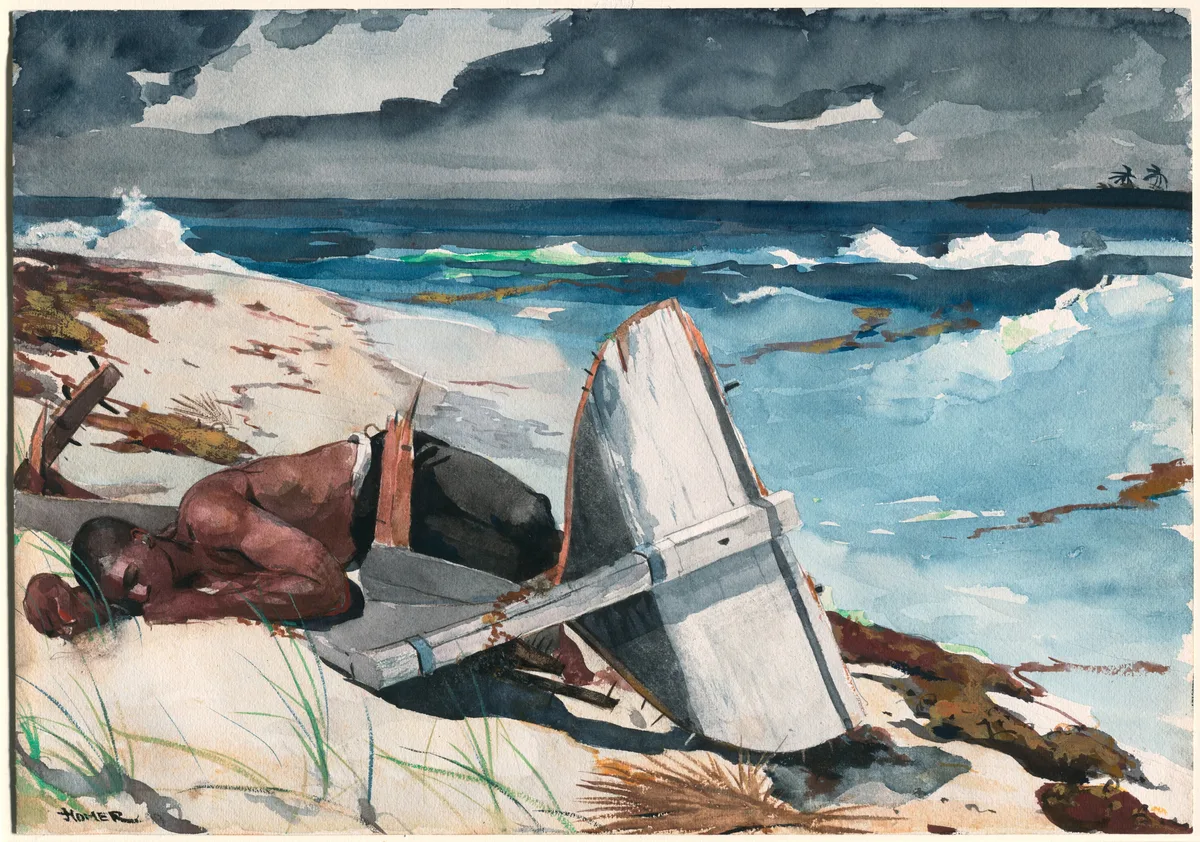
Winslow Homer, After the Hurricane, Bahamas (1899, Art Institute of Chicago): The prone figure and the wrecked boat lean together in a long diagonal triangle that mirrors the tipped horizon. The composition's instability is its meaning — the triangle is off-axis on purpose, and that tipping axis makes you feel the aftermath of the storm in your body before your brain has processed the subject. You can explore the AIC's open-access collection at artic.edu.

Pieter de Hooch, A Mother's Duty (c. 1660–61, Rijksmuseum): De Hooch anchors the mother-and-child group as a tight upright triangle inside a luminous Dutch interior. The mother's head is the apex; her broad skirt and the seated child form the base. The surrounding architecture — doors, floors, the view into a courtyard — could easily scatter the eye across a dozen entry points, but the triangular figure group holds the center of gravity firmly. Browse the full collection at rijksmuseum.nl.
Rembrandt, Portrait of a Woman, Possibly Maria Trip (1639, Rijksmuseum): Returning to the hero image — the luminous face at the apex, the vast lace collar as the intermediate station, and the gloved hands resting at the base complete a triangle that feels as inevitable as a keystone arch. Nothing in the picture asks you to go anywhere else.
Check Your Triangle in Critico
One of the harder parts of triangle composition is that you can intend a triangle and not actually produce one — the forms you meant to connect end up at the wrong value or the wrong scale to read as a coherent shape. Critico lets you drop in your own painting and see its value structure and compositional weight mapped without the distraction of color and surface. If your intended triangle isn't showing up there, it isn't showing up for the viewer either. That's the most useful thing the tool does: it tells you what the painting is actually doing, not what you planned.
Frequently Asked Questions
- What is triangle composition? Triangle composition is the practice of arranging the main elements of an image so they sit at the three points of an implied triangle — creating a visual circuit that gives the eye a path to travel and the composition a stable, readable structure.
- What is the golden triangle in composition? The golden triangle is a compositional grid made by drawing a diagonal across the frame and dropping a perpendicular from one remaining corner to that diagonal. It produces similar triangles throughout the rectangle, and elements placed along those lines tend to feel both dynamic and geometrically harmonious.
- Do triangles have to be symmetrical to work? No — and often the most interesting triangles are noticeably off-square. What matters is that the three anchor points create a clear, felt relationship, not that the triangle is equilateral or perfectly centered.
- How is triangle composition different from the rule of thirds? The rule of thirds places elements at specific intersections in a nine-part grid; triangle composition is about the shape made by three main elements regardless of where they fall in the frame. The two ideas are compatible — a triangle's three points often do land near rule-of-thirds intersections — but they address different aspects of structure. See Rule of Thirds Examples: How Master Painters Actually Used the Grid for the comparison.
- How do I know if my painting has a strong triangle? Squint until detail disappears, then identify the three brightest lights and the three deepest darks. Connect each set with an imaginary line. If either set forms a clear triangle, you have structural geometry working for you. If both sets form the same or complementary triangles, the composition is genuinely unified.
Triangle composition isn't a recipe you apply before the painting — it's a structural logic you can learn to see and then build toward naturally. Once you've internalized it, you'll find yourself placing a third mark and feeling whether it completes a circuit or breaks one. That instinct is worth developing deliberately, because it frees you from having to consciously measure: the geometry becomes a felt thing, the way a musician hears when a chord resolves.
If you want to see how your current work holds up structurally, take a look at Emphasis in Art: How Painters Tell You Where to Look for a related angle on guiding the viewer's eye — and then try your own painting in Critico.